Thursday, March 1, 2012

Endocrine Diseases and Pharmacology

Endocrine Disorders

Anterior Pituitary: (ACTH, TSH, FSH, GH, LH, Prolactin)
 – Hypo: Hypopituitarism
 – Hyper: Hyperpituitarism
Posterior Pituitary: (Oxytocin, ADH) 
 – Hypo: Diabetes Insipidus
 – Hyper: SIADH
Adrenal Cortex: (Gluco/Mineralcorticoids, Androgens)
 – Hypo: Adrenal Insufficiency (Addisons and Addisonian Crisis)
 – Hyper: Cushings Syndrome and Hyperaldosteronism
Adrenal Medulla: (Catecholamines; Epi/Norepi)
 – Hypo: Adrenalectomy can cause s/s of hypo secretion of cortex & medulla
 – Hyper: Pheochromocytoma
Thyroid
 – Hypo: Hypothyroidism and Myxedema coma
 – Hyper: Hyperthyroidism and Thyroid storm
Parathyroid
 – Hypo: Hypoparathyroidism
 – Hyper: Hyperparathyroidism
Pancreas
 – Diabetes Mellitus: Type 1 & Type 2
     • Complications: Retinopathy, Nephropathy, Neuropathy
     – Diabetic KetoAcidosis (DKA)
     – Hyperglycemic Hyperosmolar Nonketotic Syndrome


We are going to concentrate on the most frequently covered topics on the NCLEX exam:
Thyroid, Adrenal, and Parathyroid disease, as well as Diabetes and all of it's complications.

But first, keep in mind these Key Points:
• Only 2 things can happen: Hypo or Hypersecretion of an endocrine organ
• Treatment is aimed at blocking (if hyper) or replacing (if hypo) hormones
Primary disease is due to a dysfunction in the gland itself, while Secondary is due to a dysfunction in the glands' stimulating hormone.

• Look out for Meds, Hi yield points, and Precautions

Thyroid Disorders

Hypothyroidism
• 1o: Surgical resection, Amiodarone, Low Iodine, Hashimotos
Hashimotos: Autoimmune destruction, usually in women 20-60 y.o.
• 2o: Hypothalamus or Pituitary disorders
• S/S:
– Early: Fatigue, cold intolerance, wt gain, dry skin, brittle hair/nails, hi DBP
– Late: Slow speech, hoarse, loss of outer 1/3 eyebrow, myxedema (thickened skin), periorbital puffiness, low HR, effusions
– Critical (Myxedema Coma): Low Temp, Low BP, Low R, AMS
• TX: Levothyroxine (Synthroid)
– Myxedema Coma: T4 IV (can use T3 if T4 ineffective but CX for arrhythmias); Adrenal replacement meds (steroids) usually necessary

Hyperthyroidism
• 1o: 3/4 of all hyperthyroidism is Graves; Goiter, Adenoma, and Amiodarone also cause
Graves: Autoimmune induced, usually in women 20-40 y.o.
• 2o: Pituitary adenoma
• S/S:
– All: Insomnia, heat intolerance, wt loss, sweaty, fine hair, hi HR, AFib, incr. bowel movements
Graves: Above + non-tender goiter, pretibial myxedema, exopthalmos
Storm: Fever, hi HR, hi SBP/Wide pulse pressure/ low MAP (i.e. 150/40) CX: 50% MORTALITY!
• TX:
– 1o: Propranolol ( lowers HR and lowers T4/T3 conversion)
– 2o: PTU or Methimazole (antithyroid medications used as 1st line tx attempt prior to ablation of thyroid)
– 3o: Radioactive Iodine (Cat X drug used to diagnose nodules and destroy thyroid tissue; Highly radioactive so strict precautions are necessary, i.e. keep distance from pt when possible, tell pt to avoid close contact for 3 d after
Storm: BB then PTU wait 1hr then Iodide then Steroids

Amiodarone: The Thyroid Killer
• Over 10% of those treated with Amiodarone will develop hypothyroidism
– Amio looks like Iodine = Thyroid takes it up instead of Iodine = can’t make T3/T4 = Hypothyroid (often resolves in 1-3 months)
– Some have antibodies that attack and destroy thyroid when combined with amio = Hypothyroid (nonreversible)

• Up to 20% of those treated with Amiodarone will develop hyperthyroidism
– Amiodarone has a special affinity for the thyroid and when it accumulates there, tissue becomes hyperemic, allowing pre-formed T3/T4 to dump into bloodstream = Hyperthyroid (often becomes hypothyroid when supply is used up, then can normalize)


Adrenal disorders

Cushings
• Cushings Syndrome:  Hi Cortisol from any cause
• Cushings Disease:  Hi Cortisol from a Pituitary cause (2o)
Iatrogenic Cushings: Prescribed steroids (most common cause)
• Ectopic Cushings: Lung CA can release an ACTH like hormone that causes Cushings
• Patho:
Cortisol (Glucocorticoid) has the following effects on the body: Impaired collagen production,
Enhanced protein catabolism, Anti-insulin effect (hyperglycemia), Inhibitory effect on T-cells (Impaired immunity), Enhanced catecholamine activity (HT)
• S/S:
Syndrome: Central obesity, moon facies, buffalo hump, purple striae on abdomen, acne, easy bruising, HT, Hi Glucose, Hi Na, Low K, Psychiatric issues
Disease only (symptoms caused by faulty release of Melanocyte stim hormone during release of increased ACTH): Hyperpigmentation, Masculinization in females


• Diagnosis: Dexamethasone suppression test
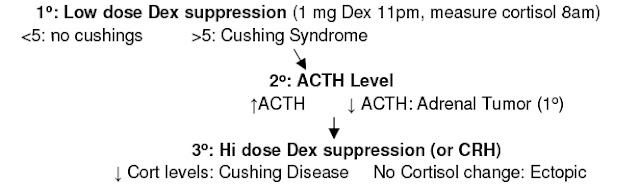
• TX: If Iatrogenic, taper steroids
– Disease: Transphenoid resection of tumor
– Adrenal: Adrenalectomy

Adrenal Insufficiency
• 1o: Addisons (autoimmune most common in 1st world, infection most common in rest); Only
type of insufficiency where aldosterone is also low
• 2o: Iatrogenic (Pts on long term steroids can not produce their own steroids when stressed or
upon abrupt withdrawal)
• S/S:
– All: Wt loss, anorexia, nausea, abdomen pain
– 1o:  Low Aldosterone (Low Na, Hi K),  Glucose, Orthostasis, Pigment (from Hi ACTH)
Addisonian Crisis: Severe Low BP, Cardiac collapse, Ab pain, ARF; Crisis brought on by stress, trauma, or infection
• Fatal if untreated
• TX: IV fluids (min 2 L D5 NS) + Hydrocortisone
• DX: 1) Measure plasma Cortisol; If Low, check Plasma ACTH, Aldosterone, and Renin
          Primary (addisons): Hi ACTH, Hi Renin, Low Aldosterone
          Secondary: Low ACTH, Normal Renin/Aldo
• TX:
– 1o: PO Hydrocortisone or Prednisone QD + Fludrocortisone QD
– 2o: Same as above but no need for Fludrocortisone since no low mineralcorticoids in 2o


Pheochromocytoma
•  Hi Catecholamines from Adrenal Medulla mass
• S/S: Very hi BP, pounding headache, severe sweating, anxiety, impending doom, hi glucose,  hi K, Hi Lipids
• DX: Urine screen for metanephrine (an epi breakdown product), will be elevated; May also
check urine/serum epi/norepi levels; CT/MRI to detect location of mass
• TX: Alpha blockers, followed by surgical resection

Hyperaldosteronism
• Usually from Adrenal Cortex adenoma (Conn’s syndrome) or hyperplasia
• Patho: Aldosterone is the primary mineralcorticoid in the body that is responsible for saving
Na in the DCT/CD of the kidneys, thus preserving water and increasing volume; K is wasted
in exchange for Na; Responds to Renin; Fludricortisone is pharm version of this hormone
• S/S: hi Na, Low K, HT, Polydipsia, Polyuria, no peripheral edema, M.Alkalosis
• DX: Aldosterone/Renin ratio (Hi/Lo which shows Renin is not the cause of hi Aldo)
• TX:
– Hyperplasia: Spironalctone
– Adenoma: Resection

Steroids: Just so you don't get confused, here is a chart that shows which of the steroids we use in the hospital have solely Glucocorticoid effects, which have Mineralcorticoid effects, and their strength compared with the natural steroid Cortisol.


Pituitary disorders

SIADH
• Often hi ADH is seen after stroke, trauma or pain due to hi blood flow and release of hormone
• Iatrogenic: Meds (SSRIs, Morphine, Oxytocin) can also cause
• Lung: CA, pneumonia or TB can release an ADH-like hormone
• S/S: Low Na (free water retention) w/CNS changes (lethargy, falls, Sz, coma), low Renin,
hypervolemia, low BUN/Creatinine
• TX:
– 1o: Water restriction (usually sufficient)
– 2o: NS + Lasix if faster results desired
– 3o: Lithium or Demeclocycline inhibit ADH if severe; May also add Hypertonic saline if neuro s/s
– CX: NEVER raise Na more than 0.5 meq/L/hr (12/d) or will develop pontine myelinolysis

Diabetes Insipidus
Central: Most common form, low ADH from surgery or head trauma
Nephrogenic: poor response to ADH due to low K, hi Ca or Lithium
• S/S: Polyuria (5-15 L/d), clear urine, polydipsia, hi Na, low Urine osmolality , hi plasma osmol
• DX: DDAVP-if response you have both diagnosed and treated central DI
• TX:
– Central: DDAVP (Desmopressin-synthetic ADH/Vasopressin that is much stronger and longer acting), nasally, PO or injection; Chlorpropramide increases response to ADH
– Nephrogenic: Thiazide diuretics (block DCT Na uptake forces PCT to reabsorb Na and water, so less water reaches the faulty ADH channels)


Parathyroid disorders

Hypoparathyroidism

• Facts: Hyposecretion of parathyroid hormone, often following thyroidectomy

• S/S:

– Subjective: Numbness/Tingling in face, depression, Muscle cramps
– Objective:
Hypocalcemia, hyperphosphatemia, Hypotension
• + Trousseau (BP cuff causes carpal spasms)
• + Chvostek (Tap facial nerve contracts face muscle)
• Hyper DTRs, Seizures
Cardiac arrhythmias, Prolonged QT interval (Primary r/o with long QT)
• TX: Calcium gluconate (Serious: IV; Mod: PO); Vitamin D
• NX:
Calcium and Vitamin D can increase Ca excretion = stones
– Initiate Seizure precautions
– Place Tracheotomy set, Oxygen, Suction at bedside
– Monitor for Tetany: s/s include arrhythmias, carpopedal spasm, dysphagia, cramping,
numbness/tingling in face/extremeties, + Chvostek/Trousseau, Seizures, Photophobia,
Wheezing/Dyspnea (Broncho/laryngospasm)

Hyperparathyroidism
• Facts: Hypersecretion of Parathyroid hormone
• S/S:
Stones: Nephrolithiasis (Renal calculi/stones)
Bones: Bone pain, Bone deformities, Pathological fractures
Groans: Muscle pains/weakness, PUD, Pancreatitis, Gout, Constipation
Psychiatric overtones: Depression, Anorexia/weight loss, lethargy
– Others: Hypercalcemia, Hypercalciuria, Hypophosphatemia, HT, Polyuria, Polydipisia, Shortened QT Interval
• TX:
Furosemide (Lasix) to lower calcium levels by up excretion
– IV fluids of NS
Calcitonin (Calcimar) to lower skeletal calcium release
  • NX:
     – Notify MD if rapid drop in Ca occurs and assess for s/s of tetany


Pancreas disorder

Diabetes Mellitus
• Facts: Inability to control blood glucose
• Type 1: Autoimmune beta islet cell destruction, usually presents as a kid, less than 10% of all DM
• Type 2: Insulin resistance = hi glucose = hi Insulin = pancreas fails = overt DM, more than 90% of DM
• S/S:
    – Type 1: Develop hyperglycemia rapidly, often after illness, usually presents in DKA
    – Type 2: Polyuria, polyphagia, polydipsia, frequent infections; May present w/comorbidities such as MI, stroke, claudication, neuropathy, proteinuria; often discovered on routine UA or sugar check  

• DX: Diabetes; 4 independent methods
    – more than126 after 8 hour fast (preferred method) (less than 110 norm)
    – more than 200 at anytime w/DM s/s
    – more than 200 2 hr after 75g oral glucose load (less than 140 norm)

    – more than 6.5 hbA1C at anytime
• DX: Impaired glucose tolerance (not quite DM but hi risk of future development)
    – 110 -126 after 8 hour fast
    – 140 - 200 2 hr after 75g oral glucose load

    – 5.8-6.5 hbA1C
• TX considerations:
HbA1C: Gives an estimate of glucose control over previous 3 mos as it measures how many
hemoglobin are coated in glucose
      • less than 5.8 (perfect); below 7% (ok); 7-8.5% (good); 8.5-10% (fair); above 10% (poor)
– Check sugar/Administer Insulin 4x/d: qmeals and qhs
– Annual urine check for albumin: Microalbuminuria (30-300) gets ACEI and Statins right away
ASA for macrovascular complications, NSAIDs for neuropathy
– Other goals: BP less than130/80, LDL less than 100, TG less than 150, HDL more than 40
Dawn Phenomenon: Morning Hyperglycemia (8am glucose hi + 3 am glucose hi = incr evening dose)
Somogyi Effect: Morning Hyperglycemia (8am glucose hi + 3 am glucose low = decr evening dose)

Type 1: Insulin required to live, SQ in ab/butt/arm/leg; Regular insulin IV for emergency or
hospital maintenance; Can also add to TPN for maint
Type 2: PO meds after diet and exercise have failed to increase sensitivity; Add insulin after PO meds have failed
– PO Hypoglycemics:
• Ex: Metformin (Glucophage)
– Lowers glucose absorption and production; hold prior to using IV contrast
– S/E: Hypoglycemia, Bloating, N/V/D
Rosiglitazone (Avandia)
– Improves insulin sensitivity
– S/E: CHF/Edema, Hives, Anemia, Increased Cholesterol, Wt gain

Acute TX of poor glucose control
DKA: (5-10% mortality)
– Almost exclusively in Type 1 diabetics
– S/S: Polyuria, dehydration, ab pain, fruity breath, AMS, low Na/Mg/Phos, hi K (but low total body), + following:
Hyperglycemia (more than 250)
Metabolic acidosis (pH below 7.3, HCO3 below 15, AG above 20)
Ketonuria/Ketonemia
– TX:
1o: IV insulin bolus (0.1 unit/kg) then IV infusion with same amount per hr AFTER making sure pt is not low K
– Continue until acidosis corrects then taper
• 1oa: NS immediately upon diagnosis
– Switch to D5NS when glucose less than 250
• 2o: Add KCl to IV fluids once K less than 5; replenish other electrolytes as necessary

Hyperosmolar Hyperglycemic nonketotic syndrome:
– Severe hi Glucose, almost exclusively in Type 2 diabetics
– Similar to DKA but usually have much higher glucose (above 600) and NO acidosis or ketonuria/emia
– Treat with fluids and low dose Insulin infusion

Hypoglycemia:
– Patho: When glucose drops to 80 = insulin levels decr ; 70 = Glucagon incr; 50 = epinephrine incr along with signs such as sweat, hi BP, hi HR, tremors; Also around 50 CNS s/s (drowsy, h/a, confused) begin
– Note: S/S from epinephrine release are absent if pt is on a BB
– TX: If pt is alcoholic give Thiamine before any other treatment to prevent encephalopathy
1o: Can eat = hi sugar food; Can Not eat = 1/2 - 2 amps D50 IV push; (Glucagon alternative option if no IV access is available, however is of no use in prolonged hypoglycemia because stores of glycogen are depleted)


Wednesday, February 29, 2012

Psychiatric Disorders and Pharmacology

Mood Disorders 
Major Depression (MD)
  • Theories of Cause 
      1. o Genetic: Genes play role but must interact w/environment to develop MD 
      2. o Biochemical: Initially thought path dysfunction of serotonin (regs sleep, appetite, libido) and norepi (energy, pleasure, concentration) cause; But prob also i/c dopamine, Ach, Gaba; Also probably not sole cause 
      3. o Hormonal regulation: Hypo-Pit-Adrenal path malfunction →↑ cortisol which is often high in depressed pts 
      4. o Circadian rhythm: Most pts w/MD have loss of deep and REM sleep 
      5. o Psychodynamic: Stressors and events trigger episode if vulnerable 
      6. o Cognitive: Experience teaches negative thoughts which depression; Three learned thoughts responsible: 1) Negative self view, 2) Pessimistic view of world, 3) No hope for future 
      7. o Learned Helplessness: Normal anxiety is replaced by depression as person learns they have no control over situations; Popular modern theory that believes remedy is teaching coping skills and self confidence (i.e. groups) 
  • Facts: *Pt presents w/history of one or more major depressive events and NO manic/hypomanic episodes; *s/s represent a change in usual behavior (slight difference from dysthymia); *Usually have more than one episode in life; *Not verbally mediated; *One episode means meds for life 
  • DX: 5 or more of following occur daily for 2 wks: 1) Depressed mood most of day, 2) Anhedonia, 3) Wt loss (5% in month), 4) Insomnia/hypersomnia, 5) or motor activity, 6) Anergia, 7) Feel worthless or guilty, 8) indecisive or concentration, 9) Death/suicide thoughts 
  • Subtypes: MD may include following features: Psychotic (halluc/delusions), Catatonic (echo, strange movement), Melancholic (wt, early morn wake), Postpartum onset (4 wks PP), Seasonal (winter), Atypical (wt, oversleep) 
  • NX: Severe vegetative (∆ in activity necessary to support life) s/s include: severe wt, psychomotor retard, early morn waking, libido; Main NX DX suicide risk after few days on meds during cycle out, coping, self carev Monitor sleep, wt/eating, bowel movements; Expect withdrawn behavior; Usual TX for MD is Cognitive behavior therapy and ECT (NPO 6hr prior; remove contacts, dentures; Give premeds 30 min prior)
Dysthymia
  • Facts: S/S represent usual behavior for 2 yrs; Less severe low, verbal mediate 
  • DX: 2 or more of: 1) or appetite (often ), 2) or sleep, 3) Anergia, 4)self-esteem, 5) Poor concentration/decision making, 6) hopelessness 
Bipolar Disorders
  • Facts: Chronic, recurrent shifts in mood, energy, and functioning; Severe mortality w/highest suicide rate of all Psych illnesses; Often starts at 20 yrs; Probable genetic influence as bipolar pts often have bipolar relatives 
  • Type 1: At least one Manic episode alternating with MD 
  • Type 2: At least one Hypomanic episode alternating with MD (often OCD) 
  • Cyclothymia: Hypomanic episode alternates with minor depression (2 yrs) 
  • Psychotic: Severely impaired mental state w/hallucination, delusion, and/or personality ∆, w/disorganized thought and loss of touch w/reality; Emergency! 
  • Mania: impairment in activity/relationships; TX needed to avoid harm to self/others; Psychotic features; S/S not due to drugs/disease 
  • Hypomania: ∆ in functioning/mood that is not ordinary for pt and can be observed by others, no impairment socially, S/S not due to drugs/disease, TX not an emergency 
  • Bipolar DX: Distinct abnormal/persistent in mood for 4 d (hypo) or 1 wk (mania), AND 3 or more of: 1) Grandiosity, 2) need for sleep (rested w/3 hrs), 3) need to be talkative, 4) Flight of ideas, 5) Distractible, 6) goal-directed activity, 7) need for unhealthy living ( spending, sex) 
  • Bipolar episodes: Mixed ( and daily for 1 wk); Rapid Cycling (4 or more episodes in 1 yr); Regular (at least 1 manic episode w/depression) 
  • Mental Status Exam: Depending upon manic () vs depressed () will show: Appearance ( bizarre dress, frequent ∆; poor hygiene); Speech ( flight of ideas, rapid; retarded); Thought ( grandiose, distracted; hope/helpless); Affect ( labile; flat/dull); Psychomotor ( hyper; retarded); Delusions ( grandeur, bizarre; negative triad); Hallucinations (any in both states) 
  • NX: Don’t let make big decision when or ; Extreme risk of self harm; Electroconvulsive therapy possible (for psychotic depression); Sleep therapy; Distractibility can be used positively during interventions; environmental stimulus (such as neutral colored rooms, coordinated accessories) 
Mood Disorder Pharmacology 
Antidepressants (MD pts)
  • Facts: All but MAOI block reuptake of serotonin and sometimes norepi making more available in synapse ( mood, alert, concentration); Can be given once a day, but often has 3-4 wk time to therapeutic effectiveness 
  • Indications for use: Recurrent depression, Psychomotor retardation, Depression w/no clear cause, Family Hx, Chronic pain, Eneuresis 
  • Types 
    • Benzodiazepines
      • Alprazolan (Zanax): Short term only as dose needed over time
    • SSRI (selective serotonin reuptake inhibitor) 
      • SSRI S/E: Sexual depression/dysfunction, N/V/D, insomnia, anxiety, dry mouth, tremor, fatigue, H/A, toxic s/e rare 
      • NX: Never take w/MAOIs, Liver/renal/CBC test, d/c meds slow 
      • Fluoxetine (Prozac): sedation, S/E
      • Sertraline (Zoloft): toxicity in OD, S/E, halflife than Prozac 
      • Paroxetine (Paxil): Safest for elderly, Lowest halflife 
      • Fluvoxamine (Luvox) ƒ Citalopram (Celexa
      • Escitalopram oxalate (Lexapro)
    • SNRIs (Serotonin/Norepinephrine reuptake inhibitor) 
      • Pros: sex probs, insomnia, response quicker, anxiolytic like 
      • Cons: BP, Sedating, Anticholinergic s/e (constipation, sweat) 
      • Effexor (Venlafaxine): S/E: dizziness, migraine, wt gain 
      • Serzone 
      • Trazodone (Desyrel
      • Remeron: S/E: somnolence, dizzi, wt gain; Adverse: agranulocytosis, neutropenis; NX: some respond well only to this
    • Norepi/dopamine agonist 
      • Facts: Stimulant inhibits reuptake and release of Norepi/dopa 
      • Cons: seizure risk ƒ Bupropion HCl (Wellbutrin): No effect on serotonin/ MAO 
    • Tricyclics (Norepi/serotonin reuptake inhibitor + minor Ach/Hista effect 
      • Examples: Imapramine (Tofranil), Desipramine (Norpramine, Pertofrane), Amitriptyline (Elavil, Endep), Nortriptyline (Pamelor, Aventyl), Protriptyline (Vivactil), Doxepin (Sinequan)
      • S/E: Anticholinergic effects (dry mouth, constipation, urinary hesitant/retention, sweating, drowsiness, blurred vision); EPS Cardiovascular (postural BP, HR, heart conduction probs); Glaucoma worsened, Toxic confusion/psychosis; Wt gain, SZ,
      • Overdose: 1000-4000 mg can be Fatal
    • MAOIs 
      • Facts: Monoamine (epi, norepi, sero, dopa) oxidase responsible for destroying excess/used MAs; Inhibiting enzyme level of all 
      • Types: Phenelzine (Nardil), Isocarboxazide (Marplan), Tranylcypromine (Parnate)
      • CX!: Some foods contain MAs (tyramine) which if not metabolized in liver causes ↑↑ HT and CVA; Foods include aged cheese, chicken liver, beer, red wine, chocolate, cold/sinus meds, diet pills; Avoid certain restaurants (Chinese); 1o s/s is severe h/a
      • S/E: BP most critical; Orthostatic BP, dizziness, appetite 
      • Key: BP is toxic effect (wrong food); BP is med caused S/E
    • Psychostimulants 
      • Facts: Meds such as Ritalin, Dexedrine, Adderall, and Cylert can be used sparingly in depression; Block reuptake and production 


Mood Stabilizers (Bipolar 1 pts)
    • Lithium 
      1. Facts: Used in psychiatric disorders non-responsive to other meds; Blood level of 0.1-1.5 key as toxic death possible. Higher only w/psychosis; Must maintain adequate salt in diet (consistent level, not too or
      2. Indications: Acute Mania, Bipolar prophylaxis 
      3. Possible use: Bulimia, Alcohol abuse, Schizoaffective (mania or depression with schizo like delusions/hallucinations/etc) 
      4. Method of action: Replaces Na+ in many neurons but creates different resting potential, limiting speed of nerve impulse = mania/hyperactive 
      5. S/E: Major risk of hypothyroidism and urine concentration probs; Parkinson like, cog wheeling, sluggish, forgetful; Chronic N/V/D so take w/food; Wt gain, Polydypsia, Polyuria, Allergic rash w/capsules 
      6. C/I: Never take with diuretics or Anticholinergic meds 
      7. Causes of toxic levels: Na intake (more room for Li); Sweating, Illness 
    • Anticonvulsants 
      • Carbamazepine (Tegratol): Used when no response to Lithium; Better for rapid cycle Bipolar; Blood levels at 6-8 mg/l
        • S/E: Sedation, Mal coordinated, agranulocytosis, aplastic anemia so NX: monitor CBC and alert for fever/sore throat; birth defects
      • Valproate (Depakene, Depakote): Used w/manic or schizoaffective; Blood levels at 50 mg/l
        • S/E: Severe/Fatal Hepatotoxicity, platelets, neural tube defects
      • Clonazepam (Klonopin): Benzo for acute mania, acute help while waiting for Lithium effects to occur ƒ S/E: Sedation, Anoxia, Disinhibition effect
Schizophrenia 
Facts: Psychotic Disorder (other PDs are schizoaffective, delusional, induced psychosis); Drug abuse (50%), nicotine addiction (90%) common; cause of death is suicide
Theories: Dopamine, Serotonin, and Norepi elevation is suspected but no concrete proof exists; Genetics plays role (45% chance with schizo twin or schizo parents) and with environmental factors is possible cause; MRI shows enlarged ventricles
4 steps to DX: (must meet all 4 for schizo dx)
  • Characteristic S/S, active phase: 2 or more of following in 1 month period: 1) Delusions, 2) Hallucinations, 3) Unorganized speech, 4) Catatonic behavior 5) Negative symptoms 
  • IF: (bizarre delusions or auditory hallucinations) AND (continuous voices or multiple voices) is enough to satisfy first step 
  • Social Dysfunction: Marked decline in social abilities (work, relations, self-care, etc) or failure to achieve expected level in adolescence 
  • Duration: Continuous s/s for 6 months w/at least 1 month of active phase s/s 
  • Rule Outs: Other mental diseases and medical conditions have been r/o; If pt has developmental disorder then must present w/ prominent hallucinations or delusions for 1 month for schizo dx 
Symptom Groups (which ones are present varies between individuals)
    • Positive
      1. Acute onset, Normal CT/neuro tests, Good response to antipsychotic meds 
      2. Types: Hallucinations, Delusions, Unorganized speech, bizarre behavior, Ideas of reference delusions (others are plotting against me) 
    • Negative
      1. Insidious onset, CT shows atrophy, abnormal neuropsychological tests, Poor response to antipsych meds, More destructive than positive s/s 
      2. Types: Blunt affect, Poverty of thought (alogia), motivation (avolition), Inability to experience pleasure (anhedonia) 
    • Cognitive: Inattentive, Distractible, Poor memory/problem solving/decisions, Illogical thinking, Impaired judgement, Can’t name familiar objects 
    • Mood: Dysphoria, Suicidal, Hopelessness 
Subtypes: Paranoid, Catatonic, Disorganized, Undifferentiated, Residual
Course of Disease: Prodromal s/s may appear up to 1 yr prior to first psychotic break
and include withdrawal, lonely, depressed, unrealistic future plans; Early phase s/s include anxiety, phobias, obsessions, compulsions, concentration/schoolwork probs 
NX: For auditory hallucinations, pt should tell voices to go away; for poisoning suspicion the nurse can taste food in pts presence,
Schizophrenia Pharmacology 
Facts
  • Inhibit neurotransmitters dopa, serotonin, norepi, histamine to psychosis 
  • S/E: Dop antagonist (parkinsonism, akinesia, akathisia, dyskinesia; (↑prolactin/amen/galactorhea) ACH antag (Blurred Vision, dry mouth, constipation, urinary hesitancy) Norepi antag (orthostatic hypotension, ejaculation probs) Hist antag (wt gain, sedate); Atropine Psychosis (Dry, Fever, Confused, Diplopia)
Atypical Antipsychotics:
  • Facts: Target (+) and (-) schizo signs w/few S/E b/c Dop antag only in limbic 
  • Olanzapine: S/E wt gain, CHO, DM 2 (best at improving cognition) 
  • Clozapine (Clozaril) S/E can be WBC so NX CBC weekly for 6mos; S/E: sedation, salivate, tachycard, dizzi; b/c of effects NOT 1st CHOICE 
  • Risperidone (Risperdol) Does not WBC but at dose just above normal causes motor probs; S/E: Sedates, orthohypo, wt gain, sex probs, CVAs; Only Atypical available in Depot Form (oil based time released SQ) 
  • Quetiapine (Seroquel) Broad antagonist especially Norepi/Hist (see S/E in 1st gen); Very few extrapyramidal symptoms (movement probs) 
  • Ziprasidone/Geodon (sero/norepi reuptake inhibitor; s/e BP, QT interval so fatal with arrhythmias, EKG and K/Mg test prior to Rx) 
  • Aripiprazole/Abilify ( dopa levels where high and dopa levels where low, s/e sedate, BP, anticholinergic) 
Traditional Antipsychotics
  • Facts: Pros: Cheap, Depot form (oil based time released SQ) Cons:Dopa receptor block in limbic/motor areas which can cause severe EPS s/e! 
    • EPS: extrapyramidal s/s: Akisthesia (restless feet), Dystonia (muscle spasm), Akinesia (heavy limbs), Parkinson like, Tardive dyskinesia (face muscle spasms) 
    • o Anti-EPS: Common meds for EPS tx are Benadryl, Cogentin, Artane
    • Common Types (Phenothiazines except Haldol, a Butyrophene) 
      • Haloperidol (Haldol): sedation, doses used to aggressive behavior,  risk of EPS, hallucinations, hypotension risk, used w/elderly
      • Chlorpromazine (Thorazine): sedation, hypotension risk, EPS risk 
      • Thiorizidine (Mellaril): Severe ECG ∆s, sudden death, Last resort med 
      • Trifluoperazine (Stelazine): low sedation, used with withdrawal/paranoia 
      • Fluphenazine (Prolixin): Very little sedation